
L-Theanine: Nature's Most Elegant Sleep Nutrient
Sometimes better sleep isn't about turning the brain off. It's about helping it let go.
Rest begins when an overactive nervous system finally slows down.
If you've ever lain awake at 2 a.m., you probably know the feeling.
Your body is tired, your eyes are heavy… but your mind refuses to cooperate. One thought leads to another; tomorrow's meeting becomes next month's mortgage… a conversation from three years ago suddenly demands a replay… You keep mulling these nagging thoughts over and over… And ironically, the harder you try to fall asleep, the more awake you become.
For millions of people, this isn't insomnia in the traditional sense.
It is called hyperarousal, a state of your nervous system that simply doesn't know how to switch all of that off.
This distinction matters because it changes how we think about sleep support.
For decades, the dominant approach has been sedation. Prescription hypnotics, antihistamines, alcohol, many herbal remedies… they all work by suppressing brain activity. They can certainly make people sleepy, but sedation isn't synonymous with healthy sleep. It often comes with next-day grogginess, impaired cognition, tolerance, or dependence.
L-theanine takes a remarkably different approach. Rather than forcing the brain toward unconsciousness, it appears to create the conditions under which sleep can occur naturally.
And that's precisely why scientists have become increasingly interested in this unique amino acid found almost exclusively in green tea.
A different way to think about sleep
L-theanine was first isolated from tea leaves more than 75 years ago. For generations, tea drinkers have intuitively appreciated something curious: despite containing caffeine, green tea often feels calming rather than stimulating.
Researchers eventually discovered one of the key reasons—theanine.
Unlike sedatives, L-theanine doesn't "knock you out." Instead, it appears to help the brain shift into a more relaxed state while preserving alertness.
This subtle distinction has become increasingly important as sleep science has evolved.
Today, researchers recognize that many sleep problems begin long before the lights go out. Stress accumulated throughout the day leaves the autonomic nervous system biased toward sympathetic ("fight-or-flight") activity; your cortisol remains elevated, and your cognitive activity continues long after bedtime.
Sleep becomes a casualty of an overactive waking brain.
If this model is correct, then perhaps improving sleep doesn't always require inducing sleep directly. Perhaps reducing anxiety and physiological arousal is enough, says modern science… That is exactly the hypothesis explored by numerous Japanese clinical studies summarized in a comprehensive review by Rao and colleagues.
The Japanese clinical experience
The review brings together several randomized, placebo-controlled studies investigating 200 mg of L-theanine, typically taken before bedtime.
Importantly, these weren't studies relying solely on participants saying they "felt better."
Researchers incorporated objective measurements, including wrist actigraphy to monitor sleep patterns, wake after sleep onset (WASO), validated sleep questionnaires, autonomic nervous system activity, heart rate variability, and pediatric sleep assessments. Together, they paint a surprisingly consistent picture.
Participants generally did not fall asleep because they became sedated. Instead, they appeared to sleep better because they were more relaxed.
Several other studies demonstrated improvements in subjective sleep quality, reduced nighttime awakenings, improved sleep efficiency, and greater feelings of refreshment upon waking.
One particularly interesting observation was the reduction in wake after sleep onset (WASO)—the amount of time spent awake after initially falling asleep. For many people, maintaining sleep is just as challenging as initiating it, and reducing these nighttime awakenings can substantially improve perceived sleep quality.
Calmer brain, not slower brain
One of the most fascinating aspects of L-theanine is that it seems to produce a state that neuroscientists sometimes describe as "relaxed alertness."
Relaxed alertness: calm wakefulness rather than drowsiness.
Electroencephalography (EEG) studies have repeatedly shown that L-theanine increases alpha brain wave activity. Alpha waves are typically observed during states of calm wakefulness—think meditation, quiet reflection, or the moments just before drifting off to sleep. Unlike beta waves associated with active thinking or stress, alpha activity reflects a brain that is awake but no longer working overtime. This observation helps explain why many participants report feeling calmer without feeling sleepy.
It also distinguishes L-theanine from conventional sedatives.
What happens inside the brain?
The exact mechanisms are still being investigated, but several appear to contribute simultaneously. L-theanine readily crosses the blood-brain barrier, where it influences multiple neurotransmitter systems.
Experimental studies suggest that it can modulate glutamate signaling, influence GABA activity, affect dopamine and serotonin pathways, reduce excessive neuronal excitation, and promote alpha-wave generation.
Rather than acting as a single receptor agonist, L-theanine appears to function more like a neurophysiological modulator, gently nudging the nervous system toward balance. This may explain why its effects tend to feel subtle yet noticeable.
The evidence extends beyond Japan
Since the publication of the Japanese review, several additional human trials have strengthened the evidence base.
Stress and anxiety
One of the most reproducible findings is L-theanine's ability to reduce acute psychological stress. In placebo-controlled studies, participants receiving L-theanine often demonstrate lower subjective stress, reduced tension, improved calmness, and better performance under stressful conditions.
Some studies have also observed reductions in physiological stress markers, including changes in heart rate variability that suggest increased parasympathetic ("rest-and-digest") activity. This is important because excessive sympathetic activation is one of the hallmarks of poor sleep.
Better sleep without daytime sedation
Perhaps the most attractive feature of L-theanine is what doesn't happen.
Across clinical studies, participants generally do not experience morning grogginess, impaired attention, reduced cognitive performance, dependence, rebound insomnia.
In fact, several studies report the opposite.
Because sleep quality improves, participants often describe feeling more alert the following day.
This distinction is particularly valuable for professionals, students, shift workers, and anyone who needs to perform mentally the next morning.
Children with ADHD
One particularly interesting randomized trial investigated boys diagnosed with ADHD. Children receiving L-theanine demonstrated significantly improved objective sleep quality measured by actigraphy. Notably, researchers did not observe increased daytime sleepiness despite better nighttime sleep. Although these findings should not be generalized beyond the studied population, they further support the idea that L-theanine improves sleep through regulation rather than sedation.
Why anxiety and sleep are inseparable
Modern neuroscience increasingly recognizes that anxiety and sleep are deeply interconnected: poor sleep amplifies anxiety, anxiety disrupts sleep. The result becomes a self-perpetuating cycle.
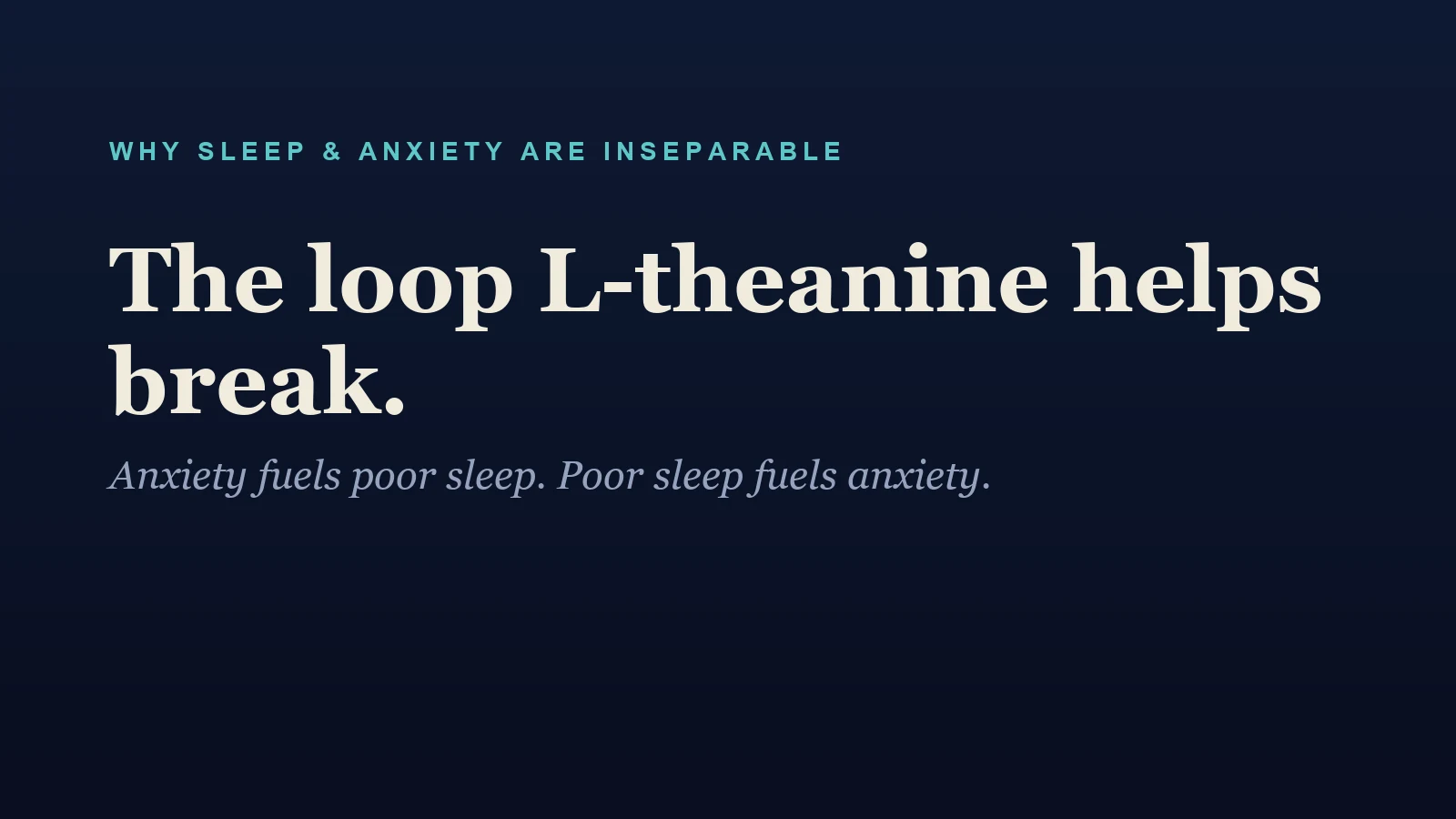
Anxiety and sleep feed each other — a self-perpetuating loop.
L-theanine appears uniquely positioned within this cycle because it addresses one of its earliest components – the heightened state of physiological and psychological arousal that prevents the brain from transitioning smoothly into sleep. Rather than overriding normal sleep architecture, it may simply remove one of the barriers preventing sleep from occurring naturally.
Safety matters
One reason researchers continue to study L-theanine is its excellent safety profile.
The review by Rao and colleagues summarizes extensive toxicological data demonstrating an exceptionally high no-observed-adverse-effect level (NOAEL), with animal studies showing safety at doses far exceeding typical human intake.
Human clinical trials likewise report excellent tolerability.
Unlike many conventional sleep aids, L-theanine has not been associated with several features mentioned above, specifically, dependence, withdrawal symptoms, tolerance, impaired psychomotor performance, and other significant adverse events.
Of course, this doesn't mean every individual responds identically, nor does it replace medical advice for chronic sleep disorders. But from a nutritional perspective, its safety profile is among its greatest strengths.
Is L-theanine a sleeping pill?
Not really.
And perhaps that's its greatest advantage. If you're expecting the immediate sedative effect of traditional prescription hypnotics, L-theanine would likely feel too gentle. But if your difficulty sleeping stems from an overactive mind, accumulated stress, or difficulty unwinding after demanding days, its mechanism makes much more sense. Instead of switching consciousness off, it appears to help restore the mental conditions under which healthy sleep can emerge on its own.
What’s next for L-theanine?
Sleep science has gradually shifted away from asking: "How can we make people unconscious?" toward a more nuanced question: "How can we restore the biology of healthy sleep?". L-theanine fits remarkably well into this modern understanding.
It doesn't replace good sleep hygiene.
It isn't a cure for insomnia.
And it won't erase every stressful day.
But a growing body of clinical research suggests it may help reduce one of the most common obstacles to restorative sleep: a nervous system that simply refuses to slow down.
Better sleep isn't always about making the brain slower. Sometimes it's about making it quieter.
Selected Scientific References
- Rao TP, Ozeki M, Juneja LR. In Search of a Safe Natural Sleep Aid. Nutrition Reviews. (Narrative review of Japanese randomized controlled trials.)
- Hidese S, et al. Effects of L-theanine administration on stress-related symptoms and cognitive functions in healthy adults: a randomized controlled trial. Nutrients. 2019.
- Lyon MR, et al. The effects of L-theanine on objective sleep quality in boys with ADHD. Alternative Medicine Review. 2011.
- Unno K, et al. Anti-stress effects of theanine on students during pharmacy practice. Biological & Pharmaceutical Bulletin. 2013.
- White DJ, et al. Anti-stress, behavioural and magnetoencephalography effects of an L-theanine-based nutrient drink. Nutritional Neuroscience. 2016.
- Williams JL, et al. Theanine as a functional food ingredient: its role in promoting mental health. Nutrients. 2020 (review).
Educational content only — not medical advice. Consult a qualified clinician before changing diet, training, or supplementation.
Elyx is Singapore’s first concierge healthspan service, based at the Raffles Hotel Arcade. To learn more about memberships, inquire here.