
Executive summary
Should you spend your next available hour on moderate aerobic exercise, high-intensity intervals, or strength training? Is creatine relevant to your goals? Does an advanced diagnostic test add information that would actually change a decision? What if a therapy or clinical trial relevant to a serious risk exists, but never enters the field of view of the people advising you?
Clinical expertise is how science becomes care. Yet modern health faces a double bandwidth problem: scientific knowledge exceeds the capacity of experts to continuously evaluate everything potentially relevant to one person, while plausible health actions exceed the time and capacity that person has to pursue them. The challenge is no longer access to information alone, but deciding what deserves attention.
AI expands scientific bandwidth. It makes it plausible to search, compare, structure, and continually update a much larger scientific universe—and to relate that evidence to a continually updated representation of one person. More information, however, does not resolve the competition among possible actions.
A useful system must do more than place a medical record into a large language model and ask for recommendations. Generating a plausible response is not equivalent to maintaining a governed path from source evidence to personal action. That path must distinguish credible evidence from weak evidence, association from intervention, population effects from personal applicability, and something that could help from something worth doing now. It must also preserve provenance and uncertainty and identify where qualified expert judgment is required.
Health maximization treats care as a repeated decision process under uncertainty:
Given what is known today, which available actions most improve the probability of the health outcomes this person values, while respecting the time, money, risk, burden, and uncertainty they are willing to accept?
Answering that question requires an architecture with two evolving representations and one decision layer:
Science Universe × Subject Universe × Context → Match → Prioritize → Explain → Action → Update
The Science Universe evaluates what the available evidence supports and with what confidence. The Subject Universe represents what is known, uncertain, and changing about one person. The decision layer tests whether the science applies, compares possible actions under real constraints, and makes the basis of those comparisons inspectable. Qualified experts contribute judgment throughout consequential interpretation and decision-making by challenging assumptions, resolving ambiguity, applying clinical context, managing safety, and remaining accountable for consequential decisions.
The result is not more health information, but a continually updated system for determining what science means for one person now.
1. Evidence over eminence
Clinical expertise is indispensable. Real patients do not resemble textbook cases, and judgment is needed to translate evidence into care. The risk is that practice-informed wisdom can become difficult to distinguish from inherited practice when the underlying evidence is neither visible nor continuously updated.
Evidence over eminence. Evidence in the hands of experts.
Health decisions draw on knowledge across specialties, guidelines, trials, diagnostic methods, and emerging research. No individual can continuously absorb every relevant publication across every domain that may affect one person's long-term health.
The central proposition is:
The science available to an individual should extend beyond the field of view of any one expert.
Choosing the best expert and finding the best available science are different problems. AI begins to separate them by expanding the field of view available to individuals and experts while preserving the judgment, accountability, and human context that health decisions require.
2. The bandwidth problem
The internet solved access to health information. It did not solve the decision problem.
Consider two people with the same serious diagnosis. One happens to see a physician connected to an academic center running a clinical trial for which they may be eligible. The other sees an equally capable physician whose network does not include that trial. The trial may ultimately be appropriate, inappropriate, beneficial, or ineffective, but only one person is likely to know that option exists. Their biology may be similar. Their field of possible action is not. Bandwidth creates the difference.
A person can now find thousands of papers, guidelines, product claims, podcasts, and AI-generated explanations. Search can identify something that might matter, but it rarely establishes:
- what the evidence actually demonstrated and how credible it is;
- whether the studied population resembles this person and the finding supports an intervention;
- whether the likely benefit justifies the risk, burden, cost, or opportunity cost; or
- what deserves attention before other plausible actions.
The harder problem is determining which few possibilities deserve attention now, which require more information, and which should not enter the plan. Science exceeds the attention available to evaluate it, while possible actions exceed the time and capacity available to perform them.
The question is no longer only, “What does my expert know?” It becomes, “What does science know that matters to me?”
3. AI changes what is possible
AI can monitor literature, discover relevant sources, extract structured claims, compare findings, identify conflicts, preserve provenance, and generate explanations from an inspectable decision record. This allows a system to continually ask which evidence may be relevant to a defined person and decision.
The distinction is fundamental:
- Search finds information about a question.
- General-purpose AI synthesizes an answer to a question.
- A health-maximization system continuously identifies and ranks which questions and actions may matter for a person—even when they did not know to ask—and makes them available for expert judgment and subject choice.
The system must also determine whether something else matters more.
A reliable system treats the model as an interpreter rather than the source of truth. Its output depends on the evidence retrieved, the distinctions preserved, the subject data interpreted, and the rules governing downstream use. A general-purpose model may summarize an observational association as advice, apply a trial outside its studied population, or treat one statistically significant result as settled science.
Health maximization therefore requires more than conversational intelligence. It requires a governed path from source evidence to personal action, with uncertainty and provenance carried through every step.
As these systems become demonstrably reliable, the question may increasingly shift from whether AI should support expert assessment to where such support improves completeness, consistency, and decision quality.
4. What health maximization means
Health maximization applies decision science to choices made under uncertainty.
The person supplies the ends. Health matters in part because it supports the relationships, activities, ambitions, independence, and experiences that matter to the individual. The system therefore allocates limited health effort in service of the life that person values, rather than maximizing biomarkers, interventions, or health activity in the abstract.
This changes how value is assessed. A marginal improvement in a health metric may not justify the time, attention, or capacity it consumes. Conversely, preserving a capability central to a person's goals may be highly valuable even when no universal health score captures that value.
At any point in time, a person faces a distribution of possible future outcomes. An action may shift that distribution, leave it largely unchanged, or introduce new benefits and harms. The relevant question is not whether an action is generically healthy. It is whether the available evidence suggests that including it in this person's portfolio is more valuable than the alternatives.
You cannot choose the outcome. You can choose how to shift the odds.
An exercise intervention may improve expected fitness while introducing injury risk and consuming time that could have been spent elsewhere. A therapy may reduce one risk while increasing another. A diagnostic may provide no direct health benefit yet still be valuable if its result changes a consequential decision.
Health maximization manages a portfolio of probabilities across the outcomes an individual values. It selects actions that shift plausible outcomes in a preferred direction while accounting for uncertainty, risk, cost, burden, and trade-offs.
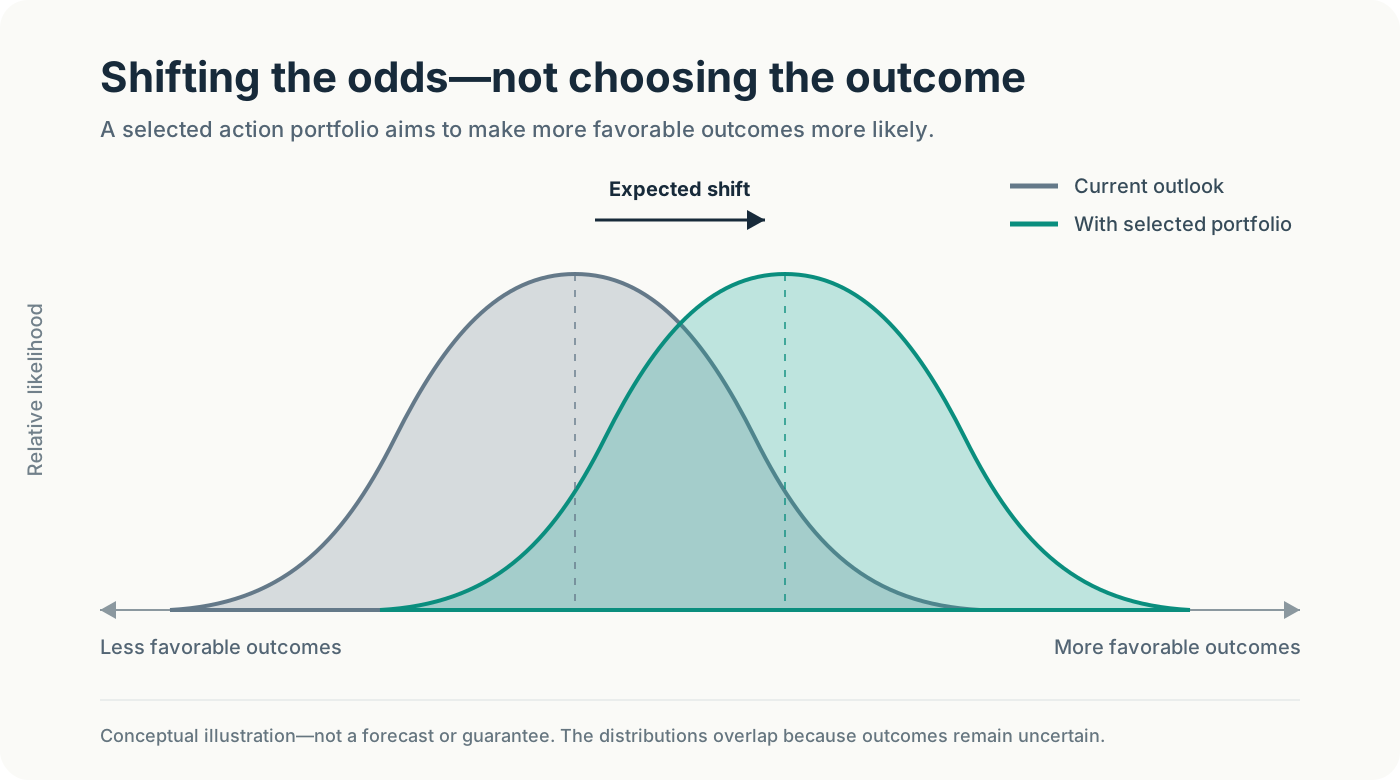
A scientifically faithful recommendation explains which outcomes may change, the expected magnitude and uncertainty of the shift, and the risks or opportunities that accompany the choice.
This framing has several consequences.
First, the output is a portfolio rather than a single recommendation. Exercise, medication discussions, sleep, diagnostics, nutrition, mental health, and monitoring may compete for the same limited time and attention.
Second, doing nothing is a legitimate option. An intervention can be biologically plausible yet too uncertain, burdensome, risky, or low-value to prioritize.
Third, measurement can itself be an action. When a missing observation could materially change the choice, obtaining that information may be more valuable than immediately choosing an intervention.
Finally, the answer is expected to change. New evidence, measurements, goals, constraints, and observed outcomes can alter both the probabilities and the preferred portfolio.
5. The architecture
The architecture separates two questions that are often collapsed: What does science support? and What does it imply for this person now?
        SCIENCE UNIVERSE                      SUBJECT UNIVERSE
    What could work, for whom?             What is true of this person?

    Discover relevant evidence             Measure observations
              ↓                                      ↓
    Evaluate and synthesize                Consolidate longitudinal context
              ↓                                      ↓
    Preserve uncertainty and provenance    Structure state, goals,
              ↓                            capabilities, risks, and missingness
              └──────────────────┬───────────────────┘
                                 ↓
                         DECISION LAYER
                    Match · Prioritize · Explain
                                 ↓
                         ACTION PORTFOLIO
                  Do · Measure · Ask · Avoid · Defer
                                 ↓
                   Expert judgment + subject choice
                                 ↓
                   New evidence + observed outcomes
                                 ↺
                        Update and re-evaluate
The two universes remain separate because scientific credibility and personal relevance are different judgments. Strong evidence may apply poorly to a person. A highly relevant hypothesis may still be too uncertain to justify action.
Context is a decision input rather than a third knowledge universe. Current time, money, access, burden, capacity, and decision-specific preferences change what is feasible and valuable now; they do not change what a study found. This separation allows a priority to change without silently rewriting the science.
Elyx is building this architecture into the operating system behind its members' healthspan programs, connecting evaluated evidence with a continually updated representation of each member to support decisions about what to investigate, prioritize, execute, measure, or defer.
6. The Science Universe
The Science Universe turns a changing evidence corpus into evaluated knowledge through four responsibilities.
Discover broadly. Search across trials, reviews, guidelines, registries, and emerging research. Public commentary can surface an idea, but the underlying source must be inspected before it enters the trusted knowledge layer.
Evaluate rigorously. Determine what each source actually supports, for which population and outcome, with what effect estimate, uncertainty, limitations, and possible bias. Assessment belongs at the level of a specific claim—not merely the reputation of a paper or journal.[1,2]
Synthesize before personalizing. One exciting paper should not become one exciting recommendation. Findings must be interpreted alongside the broader evidence, and confidence in the evidence must remain distinct from the decision to act.
Preserve provenance. Every consequential conclusion remains traceable to its scientific basis and transformation history.
Different evidence supports different inferences:
| Evidence says | The system may infer |
|---|---|
| A well-conducted randomized study found that an intervention changed an outcome in a studied population. | A candidate action, if applicability and safety support it. |
| An exposure is associated with an outcome. | A risk signal, not proof that changing the exposure changes the outcome. |
| A biological mechanism is plausible. | A hypothesis to investigate, not an intervention. |
| A clinical trial exists and a person may be eligible. | An opportunity to evaluate, not evidence that the treatment works. |
AI must preserve the boundary between what was observed and what may responsibly be done.
7. The Subject Universe
The Subject Universe is a longitudinal, quality-aware representation organized around information that can affect a decision.
Potential inputs include medical history, symptoms, diagnoses, laboratory tests, imaging, medications, genetics, wearable and behavioral data, functional capacity, goals, valued capabilities, and longer-term preferences. Personal goals help define which health outcomes matter. The system preserves when and how an observation was produced, how reliable it is, and what remains missing or disputed.
Goals can be represented as a hierarchy rather than a flat list of health targets. What a person wants their life to enable can imply valued capabilities and intermediate health goals, which then affect the value of measurements and actions. A desire to continue travelling independently, for example, may imply goals related to mobility, strength, cardiovascular capacity, and disease risk. This preserves a traceable path from what matters to the person to what enters the action portfolio.
More data is not automatically better. The question is whether an observation is valid enough, current enough, and relevant enough to change a decision.
This creates a simple but consequential inversion: your data becomes a query into relevant scientific evidence. The Subject Universe asks which study populations, eligibility conditions, outcomes, and safety constraints resemble the present decision—and which mismatches should reduce confidence or trigger expert review.
8. Match, Prioritize, Explain
This is the core of the architecture. The Science Universe may produce many credible possibilities. The decision layer determines which matter for this person now.
Match
Does this science apply to me?
A study can be excellent science and still be poor evidence for this person. Match considers whether the studied population, baseline risk, intervention, outcome, dose, setting, and time horizon resemble the present decision. It also considers contraindications, interactions, evidence certainty, and missing information.
The same relative effect can produce very different absolute benefit in two people when their baseline risks differ. Estimating the likely shift therefore depends on both the effect supported by the evidence and the person's baseline risk.[3,4]
Where the evidence supports quantitative inference, Match estimates how an action may shift relevant outcomes, carrying the available uncertainty forward rather than producing a point promise. Where the evidence is sparse or indirect, it can produce a bounded qualitative assessment. Where a responsible inference is not possible, it can abstain or propose a measurement, question, or expert review.
Prioritize
Among everything that could help, what matters most now?
Prioritization is a constrained optimization problem. It compares these possible shifts across actions and outcomes in relation to the capabilities and health outcomes the person values. Every person has finite time, money, attention, access, and tolerance for risk, so candidate actions must be compared across expected benefit and harm, evidence certainty, urgency, reversibility, information value, burden, feasibility, interactions, and personal preference.[2,5,6]
Those dimensions should not disappear inside one unexplained health score. Outcomes such as mobility, sleep, cardiovascular risk, diagnostic information, time, and burden are not naturally interchangeable.
The portfolio makes the cut line visible: what deserves attention now, what becomes worthwhile if capacity expands, and what should currently be deferred. The line can move. More time or budget may raise an action; a contraindication may lower it; a measurement may resolve enough uncertainty to promote an action—or show that it should be dropped.
Explain
Why—and what could change the answer?
Explain derives from the decision record behind the ranking. It identifies the intended outcome, evidence that influenced the result, subject factors affecting applicability, expected benefits and harms, uncertainty, constraints, alternatives, and information that could change the decision.
An explanation should make disagreement possible. A reviewer should be able to challenge the evidence, change an assumption or preference, and see whether the portfolio changes for the right reason.
9. An illustrative case: competing priorities
Consider a 52-year-old who feels healthy, has a family history of cardiovascular disease and dementia, travels frequently, sleeps poorly, has elevated ApoB, and exercises three times a week. They can devote four hours a week to their health and are willing to spend substantially, but they do not want managing their health to consume the life that health is meant to enable.
The available questions multiply quickly. Should the fourth exercise hour go to aerobic conditioning or strength? Does creatine belong in the portfolio? Is an advanced cardiovascular test likely to change management? Does sleep deserve attention first? Which emerging diagnostics are decision-changing rather than merely interesting? What is not worth doing?
A search engine can return evidence for every item. A clinician may offer strong judgment within a domain. A general-purpose AI can produce a plausible list. None necessarily resolves the competition among actions.
Suppose the person's available bandwidth allows only three priorities to receive meaningful attention this month. The system's task is to identify which three priorities most deserve that capacity, which uncertainties should be resolved before further effort is committed, and which otherwise reasonable actions can wait.
The architecture might organize the possibilities this way:
| Possible action | Illustrative placement | Reasoning pattern |
|---|---|---|
| Cardiovascular risk review | Review now | Existing risk signals could make qualified assessment decision-changing. |
| Sleep assessment | Investigate now | Better characterization could affect several outcomes and the feasibility of other actions. |
| Fourth exercise hour | Optimize now | Compare the marginal value and feasibility of aerobic and strength work for the person's goals. |
| Advanced diagnostic | Conditional | Valuable only if a plausible result would change management. |
| Creatine | Consider later | A relevant evidence signal exists, but its marginal value may be lower than unresolved higher-priority questions. |
| Novel intervention | Defer | Direct evidence, applicability, or safety may be insufficient. |
The product of the system is not more health information. It is decision compression: from everything that might matter to the few things that matter now. In this illustration, three priorities receive attention now, one remains conditional, and two wait. The value is not the exact ordering implied by a handful of facts, but a reviewable account of what deserves attention, what should be measured, and what can wait.
Three months later, the portfolio may be different. New sleep data may change the assessment. Adherence may reveal that a plan is unrealistic. A laboratory value, new paper, symptom, or travel schedule may move the cut line. The system should explain why the portfolio changed rather than simply returning a new list.
This table illustrates the decision structure; it is not a clinical recommendation.
10. AI and expert judgment
AI can take on high-bandwidth scientific work: searching, extracting, comparing, monitoring, and maintaining structured evidence. Qualified experts contribute judgment wherever interpretation or decision-making is consequential: challenging assumptions, interpreting ambiguity and clinical context, managing safety, resolving disagreement, and caring for the person.
The first beneficiary of a health-maximization system is therefore the expert. Instead of asking one person to remember and reconcile every relevant field, the system provides an evidence-linked decision record that can be inspected, corrected, approved, rejected, or deferred.
Today, AI prepares; qualified experts decide. Over time, AI can handle more scientific interpretation while expert attention concentrates on ambiguity, consequence, judgment, and human care.
Oversight should be proportional to consequence. Routine processing can use automated checks and sampled human review. High-consequence interventions, safety concerns, conflicting evidence, population mismatch, novel therapies, and unresolved disagreement require review or escalation to an appropriately qualified professional.
11. A continuously learning system
The architecture operates as a loop because neither science nor people remain static.
Observe → update evidence or subject state → re-match → re-prioritize → decide → act → observe
A new study can change confidence in an intervention. A laboratory result can change estimated risk. Attempted adherence can change the expected feasibility of a plan. An injury, symptom, new goal, or change in budget can move the cut line.
The system should not defend its previous answer. It should show what changed, how that change affected the reasoning, and why the portfolio moved. An observed improvement should not automatically be attributed to the preceding action: concurrent changes, natural variation, measurement error, and regression to the mean can all mislead.
A system supporting consequential health decisions must itself be evaluated. Each stage—from evidence retrieval through matching, prioritization, and explanation—should be tested against expert review, and higher-consequence uses should face progressively stronger standards of prospective evaluation.[7–10] The same principle applied to the science should apply to the AI: confidence is not evidence of correctness.
Conclusion
AI expands the scale at which scientific evidence can be connected to an individual. Combined with a structured, continually updated understanding of that person, it becomes possible to ask repeatedly: what does the world's evolving scientific knowledge imply for this person now?
Turning retrieval into responsible action requires an architecture that evaluates before it personalizes, separates association from intervention, distinguishes credibility from applicability, allocates limited resources across competing actions, explains uncertainty, and identifies where human judgment is required.
Elyx is developing one implementation of this architecture. The broader idea is larger than any single product: every person could have a system continuously expanding the science available to them while helping their experts determine what deserves attention.
At sufficient scale, this relationship could eventually run in both directions. A system repeatedly asking what matters for individuals will also encounter the boundaries of existing knowledge—populations insufficiently studied, interventions never compared, and consequential questions science cannot yet answer. Aggregated responsibly, those gaps could help identify where new research would have the greatest value.
The question, “What does science know that matters to me?” therefore eventually reveals another: “What does science not yet know that matters to me?”
The promise of AI in health is a more complete, disciplined, and continually updated relationship between each person, their experts, and science.
That is the architecture of health maximization.
References
- Guyatt GH, Oxman AD, Kunz R, et al. What is “quality of evidence” and why is it important to clinicians? BMJ. 2008;336:995–998. https://doi.org/10.1136/bmj.39490.551019.BE
- Alonso-Coello P, Schünemann HJ, Moberg J, et al. GRADE Evidence to Decision frameworks: a systematic and transparent approach to making well informed healthcare choices. BMJ. 2016;353:i2089. https://doi.org/10.1136/bmj.i2089
- Kent DM, Paulus JK, van Klaveren D, et al. The Predictive Approaches to Treatment effect Heterogeneity (PATH) Statement: explanation and elaboration. Ann Intern Med. 2020;172(1):W1–W25. https://pubmed.ncbi.nlm.nih.gov/31711094/
- Dahabreh IJ, Robertson SE, Tchetgen Tchetgen EJ, Stuart EA, Hernán MA. Generalizing causal inferences from individuals in randomized trials to trial-eligible target populations. Biometrics. 2019;75(2):685–694. https://doi.org/10.1111/biom.13009
- Claxton K, Ginnelly L, Sculpher M, Philips Z, Palmer S. A pilot study on decision theory and value-of-information analysis in the NHS Health Technology Assessment programme. Health Technol Assess. 2004;8(31). https://doi.org/10.3310/hta8310
- Thokala P, Devlin N, Marsh K, et al. Multiple Criteria Decision Analysis for Health Care Decision Making—An Introduction. Value Health. 2016;19(1):1–13. https://doi.org/10.1016/j.jval.2015.12.003
- Vasey B, Nagendran M, Campbell B, et al. Reporting guideline for early-stage clinical evaluation of AI decision-support systems: DECIDE-AI. Nature Medicine. 2022;28:924–933. https://doi.org/10.1038/s41591-022-01772-9
- World Health Organization. Ethics and Governance of Artificial Intelligence for Health. 2021. https://www.who.int/publications/i/item/9789240029200
- National Institute of Standards and Technology. Artificial Intelligence Risk Management Framework (AI RMF 1.0). 2023. https://doi.org/10.6028/NIST.AI.100-1
- U.S. Food and Drug Administration, Health Canada, and Medicines and Healthcare products Regulatory Agency. Transparency for Machine Learning-Enabled Medical Devices: Guiding Principles. 2024. https://www.fda.gov/medical-devices/software-medical-device-samd/transparency-machine-learning-enabled-medical-devices-guiding-principles